
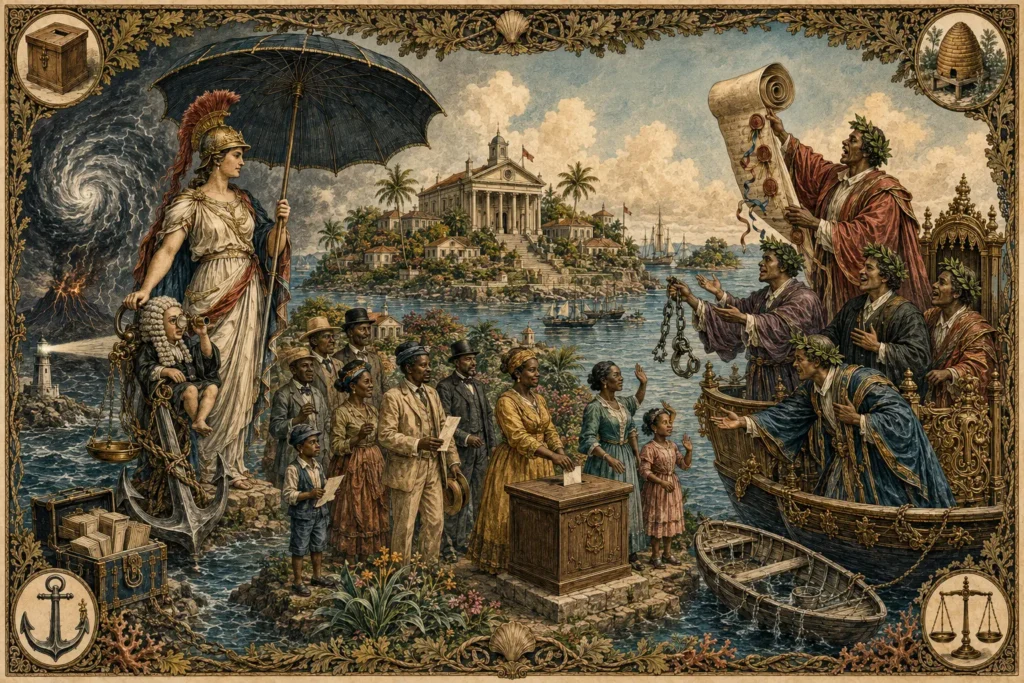
The CARICOM Reparations Commission, chaired by the historian Sir Hilary Beckles, spent four days in London this week. Its new manifesto, fifty-six pages of methodically organised indignation, now contains an unprecedented demand: that the United Kingdom “return” the British Virgin Islands, and that His Majesty King Charles III himself commit to decolonising the overseas territories that remain in the Caribbean. The region, in the professor’s words, remains the most colonised part of the world, and its people are said to live as second-class inhabitants.
The rhetoric is imposing; the democratic arithmetic rather less so. For there is one question the Commission takes great care never to ask: what if the people concerned do not want it?
The Verdict of the Ballot Box
The constitutional history of the small Atlantic and Caribbean territories is, for anyone willing to read it without ideological spectacles, a long and monotonous succession of refusals of independence.
Bermuda voted in a referendum in 1995, and nearly three-quarters of the electorate rejected sovereignty. Gibraltar, in 2002, refused even shared sovereignty with Spain by 98.97 per cent. The Falklands, in 2013, chose to remain British by 99.8 per cent. Mayotte, in 2009, voted by more than 95 per cent to become, mark this, more French, ascending to full departmental status rather than joining the neighbouring, and independent, Comoros. Curaçao and Sint Maarten, when the Netherlands Antilles dissolved, chose the status of autonomous countries within the Kingdom of the Netherlands; the independence option barely cleared five per cent. In Puerto Rico, plebiscite after plebiscite, independence remains the taste of a diminutive minority.
And then there is the case that ought to keep the manifesto’s drafters awake at night: Anguilla. In 1967 the Anguillians revolted, not against London, but against the federation with Saint Kitts and Nevis into which a hurried decolonisation had bundled them. They expelled the federation’s police and demanded, arms in hand, a return to direct British administration, which they obtained and which was formalised in 1980. Here is a Caribbean people that made its revolution in order to be a colony. The episode does not, I suspect, feature in the manifesto’s annexes.
It is worth recalling that United Nations doctrine itself, Resolution 1541 of 1960, recognises three legitimate outcomes of self-determination: independence, yes, but equally free association and integration with a state. Self-determination is the right to choose; it is not the obligation to choose what Sir Hilary would have preferred. To prescribe independence to those who have repeatedly declined it is not anti-colonialism: it is the old paternalist tutelage with the sign reversed. Wilsonian Jacobinism, which in the last century already drew borders with ruler and set-square in the name of peoples nobody consulted, now returns in post-colonial dress, with the same hauteur.
Second-Class Inhabitants?
Let the central accusation be examined. Citizens of the British overseas territories have held, since the British Overseas Territories Act of 2002, full British citizenship, with passport, residence and the right to work in the United Kingdom included. The “colonised” of the Cayman Islands enjoy a per capita product in the region of ninety-odd thousand dollars; those of Bermuda, above one hundred thousand, among the highest on the planet. Independent Jamaica, intellectual homeland of so much emancipatory rhetoric, hovers around seven thousand.
And the migratory flows, that daily plebiscite conducted suitcase in hand, all run in the same direction: it is the citizens of CARICOM’s independent states who seek work and a future in the Virgin Islands, in Cayman, in the Turks and Caicos, never the reverse. If that is second class, a great many first-class passengers appear to be requesting a transfer.
The Price of a Patron
There is, next, what the Commission calls the economic constraint of imposed constitutional arrangements, and what any economist would call, more prosaically, a guarantee.
When the Soufrière Hills volcano devastated Montserrat from 1995 onwards, it was the British Treasury that financed the evacuation, the reconstruction and, to this day, the island’s current budget. When Hurricane Irma flattened the Virgin Islands and Anguilla in 2017, the Royal Navy and the metropolitan exchequer came running. None of these islands has ever known a sovereign default, a currency crisis or an IMF rescue, experiences that several independent members of CARICOM know intimately, and repeatedly.
The very success of the Virgin Islands and the Caymans as financial centres, a success that funds the public services the Commission professes to want improved, rests precisely upon what the manifesto denounces: English law, constitutional stability, and the Judicial Committee of the Privy Council as the final court of appeal. Remove the foundation and one will discover what the edifice is worth. Capital, unlike manifestos, is not moved by sentiment: it domiciles itself where courts are predictable and the currency is stable.
To be small, insular and peripheral is a condition, not a fault; and the tie to a metropolitan power, with its legal, fiscal and military shield, is, for territories of a few tens of thousands of souls, less a shackle than an insurance policy whose premium somebody else pays. The Atlantic archipelagos that combine, in most of the cases, effective autonomy with membership of a larger state have known this for a long time.
Cui Bono?
There remains the classical question. Whom does the “return” of the Virgin Islands profit? Not the Virgin Islanders, who possess their own government and assembly and have never demanded it at the ballot box. It profits the reparations cause of CARICOM’s independent states, which have discovered in the neighbouring territories a weighty bargaining counter — now that, by Sir Hilary’s own account, the movement is entering the stage of negotiations and preparing the international judicial route. The territories are summoned as extras in a lawsuit they never filed, for a settlement they will never receive.
Sir Hilary Beckles is a historian of merit, and the memory of slavery deserves all the gravity he devotes to it. But to confuse the justice owed to the dead with tutelage over the living is a poor service to both. Liberty, one must keep repeating to its compulsive liberators, is not to be confused with sovereignty: the former belongs to men; the latter, to states. And when men, called upon to pronounce, prefer their concrete liberty to the abstract sovereignty on offer, the last word ought to be theirs.
Some emancipations impose themselves. This one has to be imposed, which tells you everything about its nature.